Set the standard
Communicate the expected execution per channel and store format, so 'compliant' means one thing.

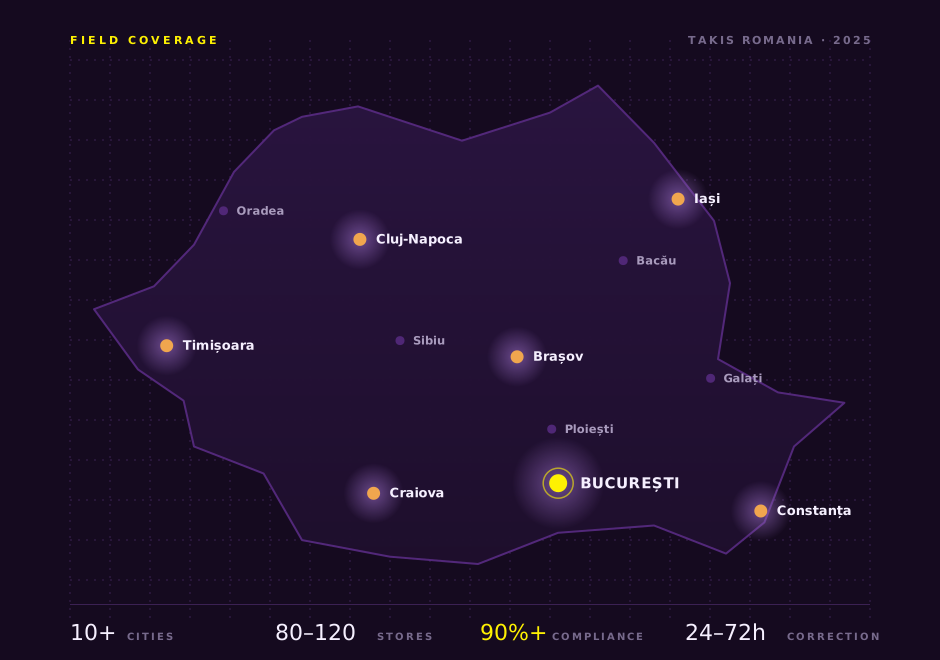
Takis entered Romania in 2025. I spent the year driving between cities to answer one question in eighty to a hundred and twenty stores: is the brand actually on the shelf the way the plan says it is? Usually not. That was the job.
Getting a global snack brand into a new country looks finished on paper long before it is. The listings are signed, the distribution is agreed, the planogram is approved, and everyone at headquarters moves on. Then the product reaches four hundred kilometres of Romanian retail and quietly becomes something else — three facings instead of twelve, bottom shelf instead of eye level, the secondary display never installed, the price tag missing.
None of that is sabotage. Stores have their own layouts, their own inventory pressure, their own priorities, and staff who were never briefed on what a new brand's launch standard is supposed to look like. Execution drifts because nobody is standing there.
For a brand nobody in the market has tried yet, that drift is expensive in a way that doesn't show up until later. Shopper awareness is built in the first weeks, at the shelf, or it isn't built at all. My job was to make the store match the plan — and where it didn't, to get it fixed within days rather than quarters.
A shopper never sees your strategy. They see forty centimetres of shelf.
Modern trade and key supermarket locations, audited through the launch phase and again post-launch — so execution was measured as the brand settled in, not just on opening week. Coverage across that many formats meant the findings were patterns rather than anecdotes.
An audit is only useful if it produces comparable numbers. Same criteria, same scoring, same photographic record in every store — which is what turns a day of driving into something a regional team can act on.
Correct level, correct zone, brand blocking intact
Tag present, price matches recommendation
Location, grouping, shelf alignment
Materials present, positioned, visible
On-shelf gaps and out-of-stock conditions
Can a shopper find it fast, against competitors
Presence, location, condition, stocking
This was the weakest category all year, and it stayed the weakest. Main-shelf execution is governed by a planogram someone can point at; a secondary display depends on floor space, a physical unit arriving, and someone agreeing to give up a position another brand already occupies. It has more ways to fail, so it failed more — which is exactly why it got the extra visit frequency.
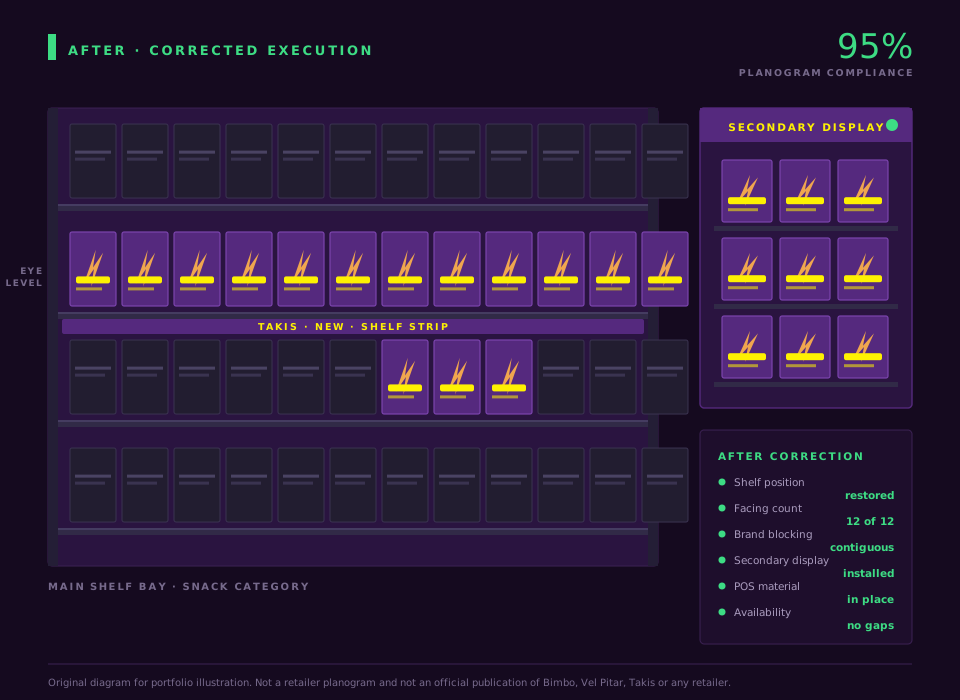
This is the whole job in one bay. Left of the toggle, a launch that technically has distribution: three facings pushed to the end of an eye-level row, no secondary display, no shelf strip, two gaps where product should be. Right of it, the same bay after the correction was agreed with the store manager and verified — twelve facings brand-blocked at eye level, the display installed, the POS in place.
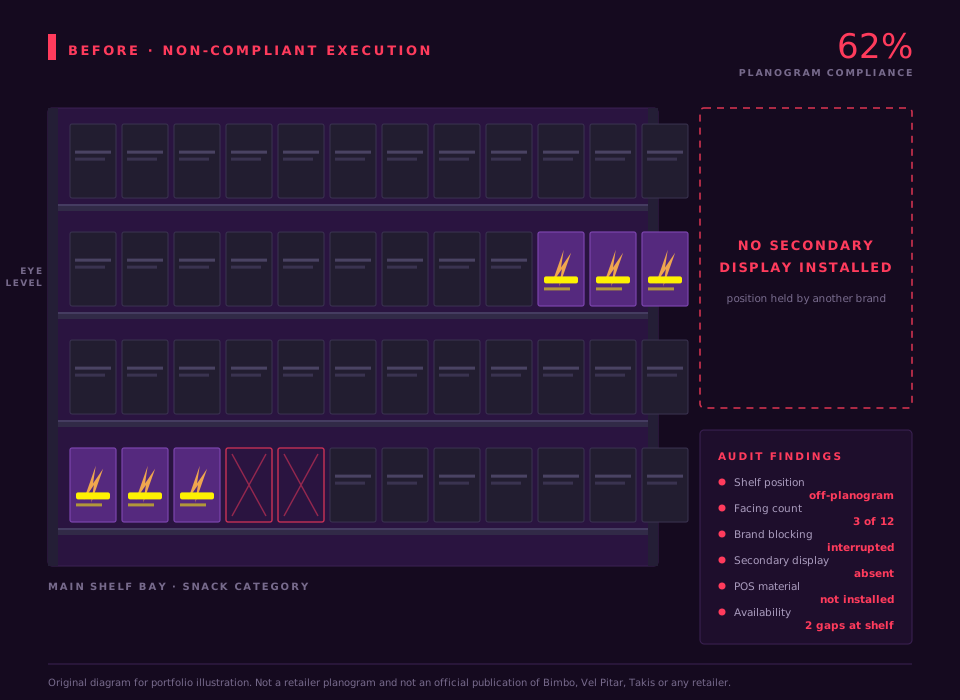
Representative of the correction pattern, not a specific store. Original diagram — not a retailer planogram.
An issue in a report changes nothing. The correction only counts once someone has confirmed it happened.
Every day a new product sits mispositioned is a day of trial you don't get back during the only window that builds awareness.
Store managers fix things faster when the conversation is a shared problem rather than an audit finding read out loud.
Evidence at audit and at correction is what makes the reporting honest — and what stops the same issue being re-logged next month.
Communicate the expected execution per channel and store format, so 'compliant' means one thing.
Structured field visit. Score every compliance area. Photograph the baseline.
Classify each non-compliant finding by category and by commercial impact — not everything is urgent.
Engage the store manager or regional team. Agree a specific action and a deadline before leaving.
Confirm inside the SLA. Photo evidence before the issue is closed. No verification, no close.
Weekly summary by city and chain, resolution rate, top three observations, next week's priorities.
Most issues die at level one. The tiers exist so the ones that can't be solved in the aisle don't sit there for a month waiting for someone to notice.
Field specialist resolves directly with the store manager. Shelf position, facing count, POS placement, price tag.
Regional retail team. Display sourcing, repeated non-compliance across a chain, material deployment failures.
HQ trade marketing. Availability and supply gaps, structural constraints, anything needing a commercial decision.
Across the network, non-compliant execution was commonly identified, communicated and corrected within 24–72 hours.
Being in a hundred stores a year makes you the only person in the company who can see the market rather than the deck. I reported every observation in the same three parts — what I saw, why it mattered commercially, and what we could do about it — because an observation without a recommendation is just trivia.
Established competitors held consistent facing counts and unbroken brand blocking at the moment Takis entered.
That set the shopper's baseline expectation. A new brand has to reach at minimum comparable visibility to compete for a first trial.
Prioritise facing-count compliance and brand blocking in stores where competitor presence is strongest; use secondary placement where main shelf space is constrained.
Promotional and display investment from competitors varied sharply between locations and chains — heavy in some, near-absent in others.
A uniform Takis execution did not produce uniform standout. In heavily contested stores, matching the standard wasn't enough to be seen.
Use field data to find where competitor display investment is highest, and put corrective effort on Takis secondary display compliance there first.
Takis price position relative to nearest competitors varied by store format, and some environments showed category benchmarks well off the national average.
Price shapes trial for a brand nobody has tasted yet — and inconsistent pricing is a compliance exposure as much as a commercial one.
Check price position against the nearest category competitor at every visit; flag deviations to the commercial team rather than correcting them in the aisle.
In hypermarkets shoppers browsed the category; in smaller formats the decision was fast and habitual.
The same execution standard does different work in different formats. Visibility wins a browse; availability and consistent placement win a habit.
Weight display and secondary placement effort toward high-browse formats, and treat availability as non-negotiable everywhere.
Some stores physically could not meet the display standard — fixture space, layout, and operating practice made full compliance impossible.
Scoring a store non-compliant every cycle for something it cannot fix produces noise, demoralises the store, and hides the real problems.
Document structural constraints and send them upward so the standard can be adapted for that format — rather than logging the same unresolvable issue forever.
High-traffic secondary positions sat occupied by lower-priority brands, or empty, in stores where nobody had asked for them.
During the launch window, an unclaimed visibility position is the cheapest awareness available — and it goes to whoever asks.
Route the opportunity to the regional commercial team to raise with the retailer, and re-check availability of that position on the next visit.
Execution compliance held above 90% across the audited network through launch and post-launch, with non-compliant execution commonly corrected inside 24–72 hours of being found. Beyond the score, the programme produced something the business didn't have before: a continuous, structured read on what was actually happening in Romanian stores — competitor movement, pricing reality, format differences, and which constraints were worth solving centrally.
No sales or sell-out figure is claimed here. Execution compliance is what this work is measured on, and it is what I can stand behind.
Independent portfolio case study describing work completed as a Trade Marketing Specialist at Bimbo Romania / Vel Pitar. Store names, retailer identities and commercially sensitive data have been omitted or anonymized. All visuals are original diagrams created for this portfolio. Not an official publication of Bimbo, Vel Pitar, Takis, or any retailer.